Sunday, 15 March 2026.
This week we come to the fourth Sunday in Lent, also known as Laetare Sunday, where we look at the triumph of light over darkness.
There’s something about the story in John 9:1–41 that feels very familiar the older I get. Maybe it’s because by the time you reach your fifties, you’ve lived long enough to know what it feels like to be misunderstood, judged too quickly, or quietly overlooked. You realise that sometimes, when you think you see most clearly, you actually see the least.
In this passage from the Gospel of John, Jesus encounters a man who has been blind from birth. The disciples immediately want an explanation. Who sinned? they ask. Was it the man? His parents? They assume there must be a reason, a fault, someone to blame.
If I’m honest, I recognise that instinct. Don’t we all do that sometimes? When something difficult happens, to us or to someone else, we search for a tidy explanation. We want life to make sense. But Jesus simply says that this man’s life will reveal the work of God.
And then He heals him.
Just like that, a man who has never seen light, colour, faces, or sky suddenly sees the world for the first time. Imagine that moment. The shock. The wonder. The overwhelming beauty of it all.
But what strikes me most about this story isn’t just the miracle. It’s what happens afterward.
Instead of celebrating, the religious leaders begin interrogating the man. They question his parents. They argue about the rules. They debate whether the healing was done properly because it happened on the Sabbath. While the man is standing there experiencing the most extraordinary moment of his life, the people around him are busy analysing it.
It’s sad that we can sometimes get get so focused on the rules, or who’s to blame that we miss the obvious hand of God right in front of us.
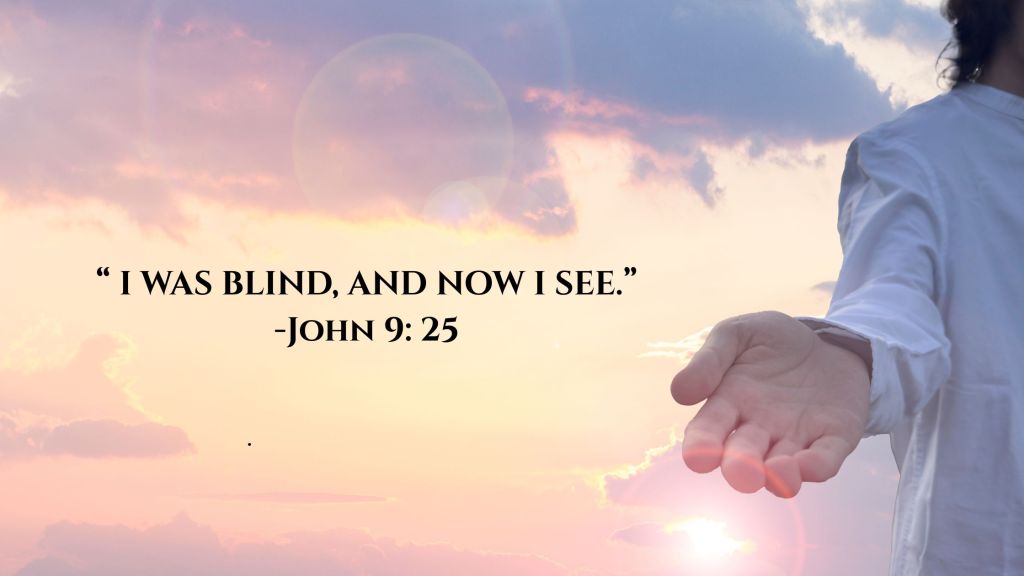
The man born blind, though, is wonderfully straightforward. He doesn’t have a theological argument ready. He simply says, “One thing I do know: I was blind, and now I see.”
There’s something beautifully refreshing about that kind of faith. It isn’t complicated. It’s honest and child-like.
At this stage of life, I find myself appreciating that simplicity more and more. My faith at twenty was shamefully lacking in depth and understanding yet somehow full of that arrogant and overly confident certainty of youth. My faith at this stage of life feels quieter, humbler. I don’t have answers for everything, and accept that I don’t understand everything I should. Like the man in the Gospel, the one thing I do know is everything that God has done in my life. And maybe not even the full extent of that.
Another thing that touches me in this story is the courage of the healed man. He’s questioned, challenged, and eventually thrown out by the authorities. Yet he sticks to the truth of what he experienced. There’s a lesson in that too. Especially when navigating the world we live in, faith often requires a quiet courage. Nothing dramatic, but the willingness to stand by what we know to be true.
Then comes the most beautiful moment of the story. After the man is cast out, Jesus seeks him out again. He finds him. He speaks to him. And the man comes to believe in Him. I love that Jesus doesn’t abandon him once the miracle is done. He goes looking for him.
That’s a comfort to me these days. Life has a way of humbling us: children grow up, bodies change, plans don’t always unfold the way we expected. But this Gospel reminds me that Christ continues to seek us out, again and again.
Perhaps the most confronting part of the passage is the final twist. Jesus says that those who cannot see will see, and those who think they see will become blind. In other words, the real blindness isn’t physical. It’s spiritual pride.
And if I’m honest, that’s something I’ve had to rein in, the temptation to think I’ve got things figured out. But the Gospel gently reminds us that faith begins with humility, and the willingness to admit that we don’t see everything clearly.
Maybe that’s why this story speaks so deeply to me right now. Because faith, like sight, is something God keeps restoring in us little by little.
Every day He opens our eyes just a bit more to His grace, truth, and to the quiet ways He’s at work in our lives.
And maybe the most faithful prayer we can offer is the same simple testimony of that once-blind man:
“I was blind, and now I see.”
 The Sojourner Diaries
Leave a comment